Is your eyelid affecting more than your looks?
A drooping eyelid isn’t always just cosmetic.
Find out with our $188 (NETT) ptosis assessment if ptosis is affecting your vision, and what can be done about it, medically or aesthetically.

Do any of these sound familiar?
- One eye looks noticeably smaller than the other in photos
- Your eyelids feel heavy or tired, especially later in the day
- You raise your eyebrows or tilt your head back just to see clearly
- You get frequent headaches or eye strain without a clear cause
These may be signs of ptosis, a condition where the upper eyelid droops lower than normal.
While many people first notice ptosis because their eyes look uneven or tired, the bigger concern is that the eyelid may gradually block part of your vision.
Understanding the condition
Ptosis is more than a cosmetic concern
Ptosis occurs when the muscle that lifts your upper eyelid (the levator muscle) weakens or loses its attachment.
The eyelid gradually sits lower, and over time, it can begin to encroach on your field of vision.
In children, untreated ptosis can interfere with visual development. In adults, it typically worsens with age, contact lens use, or following eye surgery. Either way, early evaluation matters.
Partial Vision Block
The drooping eyelid covers the upper pupil, reducing your visual field without you fully noticing.
Chronic Eye Strain
Constantly lifting your brows to compensate leads to tension headaches and forehead fatigue.
End-of-Day Heaviness
Symptoms often worsen later in the day as muscles tire, a key diagnostic indicator.
Visible Asymmetry
One eye appearing smaller than the other is often the first sign that prompts people to seek help.
Because ptosis affects both vision and eyelid structure, proper evaluation is best done by an oculoplastic surgeon, a specialist trained in eyelid and orbital conditions.
Why See an Oculoplastic Specialist for Ptosis?
Drooping eyelids can sometimes signal a serious underlying condition (from myasthenia gravis to a cranial nerve palsy) that needs urgent medical attention. A proper diagnosis distinguishes between what looks cosmetic and what may be neurological.
As an oculoplastic surgeon, Dr Roy Tan is specifically trained in both the functional and aesthetic dimensions of the eyelid. This dual expertise ensures you receive a diagnosis that is both accurate and complete
1. Functional Assessment
Precise measurement of eyelid height, muscle strength, and visual field impact, not just appearance.
2. Medical Diagnosis
Evaluation for systemic causes such as nerve palsy or neuromuscular conditions that require separate treatment.
3. All Ages, All Causes
From congenital ptosis in children to age-related drooping in adults, a single specialist for every age.
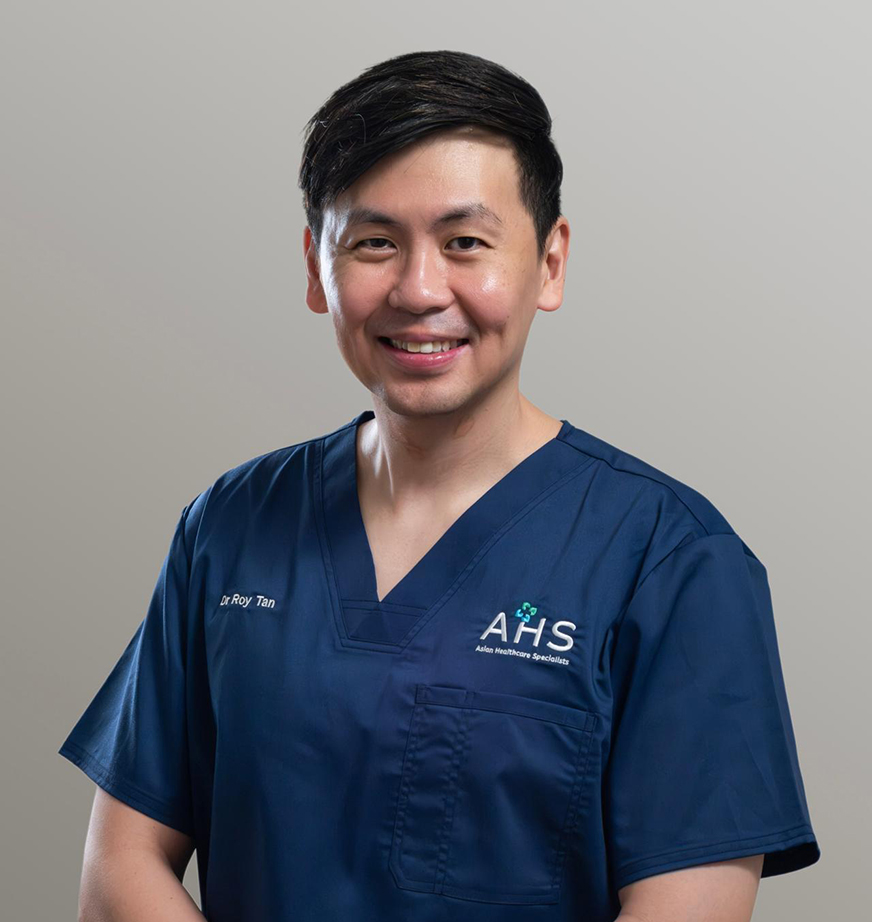
Dr Roy Tan
MBBS (Singapore), MMed (Ophthalmology), FRCOphth (UK), FAMS
About Dr Roy
- Fellow of The Royal College of Ophthalmologist (UK) and Academy of Medicine (FAMS)
- Trained in Oculoplastic and Orbital surgeries
- Clinical lecturer at NUS and Lee Kong Chien School of Medicine
- National award for quality service (Excellent Service Award (EXSA) – Silver) in 2016
What’s Included in Your $188 Screening
Your screening includes a structured eyelid and vision assessment performed by Dr Roy. These measurements help determine whether your eyelid position is within the normal range or clinically significant.
Key measurements and tests include:
Marginal Reflex Distance 1 (MRD1) Measurement
Measures the distance between the eyelid margin and the centre of the pupil to determine how much the eyelid is drooping.
Palpebral Aperture (PA)
Measures the distance between the upper eyelid margin and lower eyelid margin
Eye movement and pupils
Assess for other potential medical causes of ptosis (e.g. myasthenia gravis, cranial nerve 3 palsy, horner’s syndrome) which should be treated medically, and in some cases, urgently.
Levator Muscle Function Test
Evaluates the strength of the eyelid lifting muscle.
Eyelid Position and Symmetry Assessment
Compare both eyelids to determine asymmetry and severity.
Visual Field Impact Assessment
Check whether the eyelid is blocking your upper field of vision as required in some cases to justify functional ptosis for insurance or Medisave claims.
Photographic Documentation
Standardised photos may be taken to objectively assess eyelid height and symmetry.
Consultation with a Specialist
Have your results explained clearly by an experienced oculoplastic surgeon. There’s no pressure to commit to treatment, and no hidden fees – just straightforward advice and care.
Treatment Tailored to Your Condition
Whether your ptosis is mild and cosmetic or significant and affecting your vision, there is a treatment pathway suited to you.
Dr Roy will recommend options based on your specific measurements and goals.
Observation & Monitoring
For mild ptosis that does not affect vision, a structured watch-and-wait approach with periodic review ensures early intervention if the condition progresses.
Botox Repositioning
In carefully selected cases, Botox can relax compensatory muscles around the brow and eyelid to reduce heaviness and improve symmetry without surgery.
Ptosis Repair Surgery
A procedure to tighten or reattach the levator muscle, restoring natural eyelid height. Addresses both the functional limitation and the cosmetic asymmetry.
Insurance & Medisave Eligibility
When ptosis meets clinical criteria as a medical condition (particularly where vision is affected) surgery may qualify for Medisave use and insurance claims.
Dr Roy will advise you on eligibility based on your screening results.
- Eligibility is determined during the screening, not assumed, proper documentation matters
- Visual field testing provides the objective evidence required for Medisave claims
- Both insurance claims and Medisave use may be possible when medically indicated
- Dr Roy's clinic guides you through the claims process if you proceed with surgery
FAQ about the ptosis screening
What's the difference between going to a plastic surgeon and an oculoplastic surgeon for ptosis treatment?
An oculoplastic surgeon is a subspecialist who trained as an ophthalmologist first, then completed advanced fellowship training specifically in eyelid, orbital, and tear duct surgery. This dual background means they assess your eyelid from both angles, whether it looks uneven and whether it’s affecting how you see.
For ptosis specifically, this matters because the right treatment depends on an accurate diagnosis. A drooping eyelid can be purely cosmetic, functionally impairing your vision, or occasionally a sign of a neurological condition that needs urgent attention. Only a specialist trained in both the eye and the eyelid can reliably tell the difference, and treat it accordingly.
Is the $188 all-inclusive?
Yes. The $188 screening covers all tests listed above and a consultation with Dr Roy, with no additional hidden fees.
Additional tests may be required at extra cost if ptosis related to systemic conditions is suspected or detected.
Do I need to prepare anything before the appointment?
No special preparation is needed. Just bring your current glasses (if any) and any previous eye health records, if available. Please do not wear contact lenses to the appointment.
Are eye screenings painful?
No, the screening is painless and non-invasive. Some tests involve looking at lights or gentle air puffs to measure eye pressure, but they are quick and comfortable. Most patients feel completely at ease during the process.
Book Your $188 Ptosis Screening Today
Don’t wait for severe symptoms to appear before taking action.
Early detection is key to preserving your vision.