
Age-Related Macular Degeneration (AMD): Early Warning Signs You Might Miss
Key Takeaway (TL;DR):
Age-Related Macular Degeneration (AMD) is a leading cause of vision loss in Singapore, subtly damaging the central vision you need for reading and recognising faces. Early signs, like slight blurriness or wavy lines, are often dismissed as normal ageing. This guide explains these easy-to-miss symptoms, the critical difference between dry and wet AMD, and why early detection with a specialist like Dr Roy Tan is your best defence against sight loss. If you’re over 50 and notice any changes, a comprehensive eye assessment is your most important next step.

About Dr Roy Tan
Dr Roy Tan is an expert Consultant Ophthalmologist at Asian Healthcare Specialists (AHS). With specialized training in comprehensive eye care, he is dedicated to the early diagnosis and precise medical management of retinal conditions like Age-Related Macular Degeneration (AMD), ensuring patients protect their central vision and maintain their quality of life.
As our population ages, Age-Related Macular Degeneration (AMD) has become a significant concern in Singapore. It’s a condition that doesn’t shout; it murmurs. And because its early warning signs are so easy to miss or explain away, many people only seek help when more central vision is lost. The good news? When caught early, there are effective ways to manage AMD and protect your precious sight. Let’s learn to listen to what your eyes might be trying to tell you.
What Exactly is Age-Related Macular Degeneration?
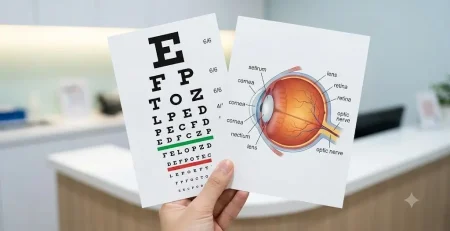
Think of your eye like a sophisticated camera. The lens at the front focuses light onto the retina at the back—this is your ‘film’ or ‘image sensor’. Right at the centre of the retina is a tiny area called the macula. It’s only about the size of a grain of rice, but it’s responsible for all your sharp, detailed, central vision. It’s what lets you read, drive, recognise faces, and see colours vividly.
Age-Related Macular Degeneration is, as the name suggests, a deterioration of the macula over time. It’s like the most sensitive part of your camera’s sensor slowly wearing out. The rest of the retina (your peripheral vision) usually remains intact, so complete blindness is rare. However, losing your central vision can profoundly impact your independence and quality of life. Understanding AMD symptoms in Singapore starts with knowing where the problem occurs.
5 Early Warning Signs You Shouldn’t Ignore
These are the subtle changes that often get mistaken for normal ageing or simple eyestrain. If you notice any of the following, it’s time to pay closer attention.
- Blurriness in Your Central Vision – This isn’t the general blur of a dirty windscreen. It’s a specific smudginess right in the middle of what you’re looking at. You might find words on a page lose their sharp edges, or that faces lack a clear definition, even with your updated glasses. It often starts in one eye, making it even easier to compensate and ignore.
- When Straight Lines Look Wavy or Bent (Metamorphopsia) – This is one of the most telling early AMD signs. Look at the tiles on your floor, the lines on a ruled notepad, or the edges of a door frame. Do they appear distorted, bent, or wavy? This distortion is a classic red flag that the macula is being pulled or distorted by underlying changes.
- A Growing Need for More Light – If you find yourself constantly turning up lamps or needing the overhead light on for tasks that used to be fine in ambient light—like reading a menu or threading a needle—it could signal that your macula is becoming less efficient at capturing light.
- Colours Seem Washed Out, or Dull – The world may start to look a little faded. Colours might not pop as they once did, and distinguishing between similar shades, like navy blue and black, can become harder. This loss of contrast sensitivity is a common early symptom.
- A Persistent Dark or Empty Spot – Imagine a small smudge or shadow right in the centre of your vision that doesn’t go away when you blink. This ‘blind spot’ can start very small but may gradually increase, obscuring the very thing you’re trying to look at directly.
Dry vs Wet AMD: How the Symptoms Differ
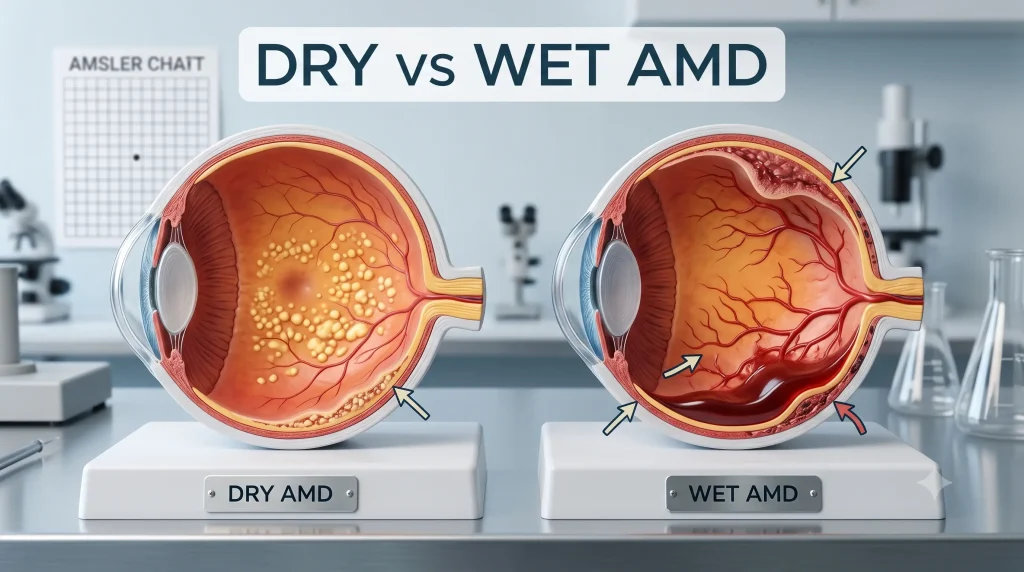
Understanding the two forms of AMD is crucial, as their progression and urgency differ significantly.
| Dry AMD (Atrophic) | Wet AMD (Neovascular) |
|---|---|
| This is the more common, slower-moving form. It involves a gradual breakdown and thinning of the light-sensitive cells in the macula. The early signs of macular degeneration listed above—slow blurring, need for light, faded colours—are typical of dry AMD. Tiny yellow deposits called ‘drusen’ are often visible to a specialist. While there’s no cure, its progression can often be managed. | This is less common but far more aggressive. It occurs when abnormal, fragile blood vessels grow under the macula and leak fluid or blood. This can cause sudden and rapid changes: a dramatic increase in distortion, a sudden dark spot, or a rapid loss of central clarity. Wet AMD is a medical urgency that requires prompt treatment to prevent severe vision loss. |
Who is at Risk in Singapore?
While age is the single biggest factor (especially for those over 60), other elements combine with our local lifestyle to influence risk:
- Family History: Genetics play a strong role. If a parent or sibling has AMD, your risk is higher.
- Smoking: This is the most significant controllable risk factor. Smoking damages blood vessels throughout the body, including those in the eyes.
- Diet: A diet low in leafy green vegetables (like kangkong or spinach) and antioxidant-rich fruits may increase risk.
- Cardiovascular Health: Conditions like high blood pressure and high cholesterol, which are prevalent here, can affect eye health.
- Prolonged Sun Exposure: Unprotected exposure to UV rays over a lifetime may contribute to macular damage.
At-Home Check: The Amsler Grid Test
You can monitor for distortion—a key symptom—at home using an Amsler grid. It’s a simple checkerboard pattern with a dot in the centre.
- Wear your reading glasses if you use them.
- Cover one eye.
- Look directly at the centre dot from about a normal reading distance.
- While focusing on the dot, check if any lines look wavy, blurry, or broken, or if any areas are missing or dark.
Important: This is a helpful monitoring tool, not a diagnostic one. It does not replace a comprehensive eye exam by a specialist. If you see any changes on the grid, it’s a clear signal to seek professional assessment.
Why See Dr Roy Tan at Asian Healthcare Specialists?
Navigating concerns about your central vision requires compassionate expertise. At Asian Healthcare Specialists, Dr Roy Tan provides a clear, supportive pathway.
A consultation involves a thorough discussion of your symptoms and history, followed by a detailed examination. The cornerstone of modern AMD diagnosis in Singapore is Optical Coherence Tomography (OCT), a quick, non-invasive scan that creates a detailed cross-sectional map of your macula. It can reveal thinning, fluid, or drusen long before symptoms become severe.
Your personalised management plan depends on the type and stage of AMD. For dry AMD, this focuses on specific nutritional guidance (including the proven AREDS2 formula of supplements), lifestyle advice, and a regular monitoring schedule to watch for changes. For wet AMD, we discuss timely intervention with treatments like anti-VEGF injections, which are highly effective at stabilising vision by controlling the leaky vessels. Our approach is always centred on preserving your vision and maintaining your quality of life with clarity and care.
Frequently Asked Questions (FAQs)
Q: I’m over 60. How often should I get my eyes checked for AMD?
A: If you have no symptoms or risk factors, a comprehensive dilated eye exam every two years is advisable. If you have risk factors like a family history or are a smoker, an annual exam is recommended. After an initial assessment, your specialist can advise on a personalised schedule.
Q: Can diet really help with macular degeneration?
A: Yes, research strongly supports a protective role for diet. A diet rich in dark leafy greens, yellow and orange fruits and vegetables, and fish high in omega-3s supports macular health. For some with intermediate dry AMD, specific nutritional supplements (based on the AREDS2 formula) may be recommended by your specialist to help slow progression.
Q: What does macular degeneration treatment in Singapore involve for the wet form?
A: The primary treatment is anti-VEGF injection therapy. The eye is numbed with drops, and a tiny amount of medication is injected to stop the growth of leaky blood vessels. It’s a quick in-clinic procedure focused on preserving your existing vision. The goal is to stabilise the condition and prevent further loss.
Q: Is there a cure for AMD?
A: There is currently no cure that reverses the condition. However, for wet AMD, modern treatments are very effective at halting progression. For dry AMD, management focuses on slowing progression. In all cases, early detection is paramount for optimal long-term visual outcomes, enabling timely intervention and management.
Don’t Let Subtle Signs Become Significant Vision Loss
If you’ve noticed any changes in your central vision, or if you’re over 50 with risk factors, taking proactive steps now is the most powerful thing you can do.
Schedule a comprehensive retinal assessment with Dr Roy Tan. Let us provide you with a clear diagnosis, personalised advice, and the compassionate, expert care you need to protect your sight for years to come.